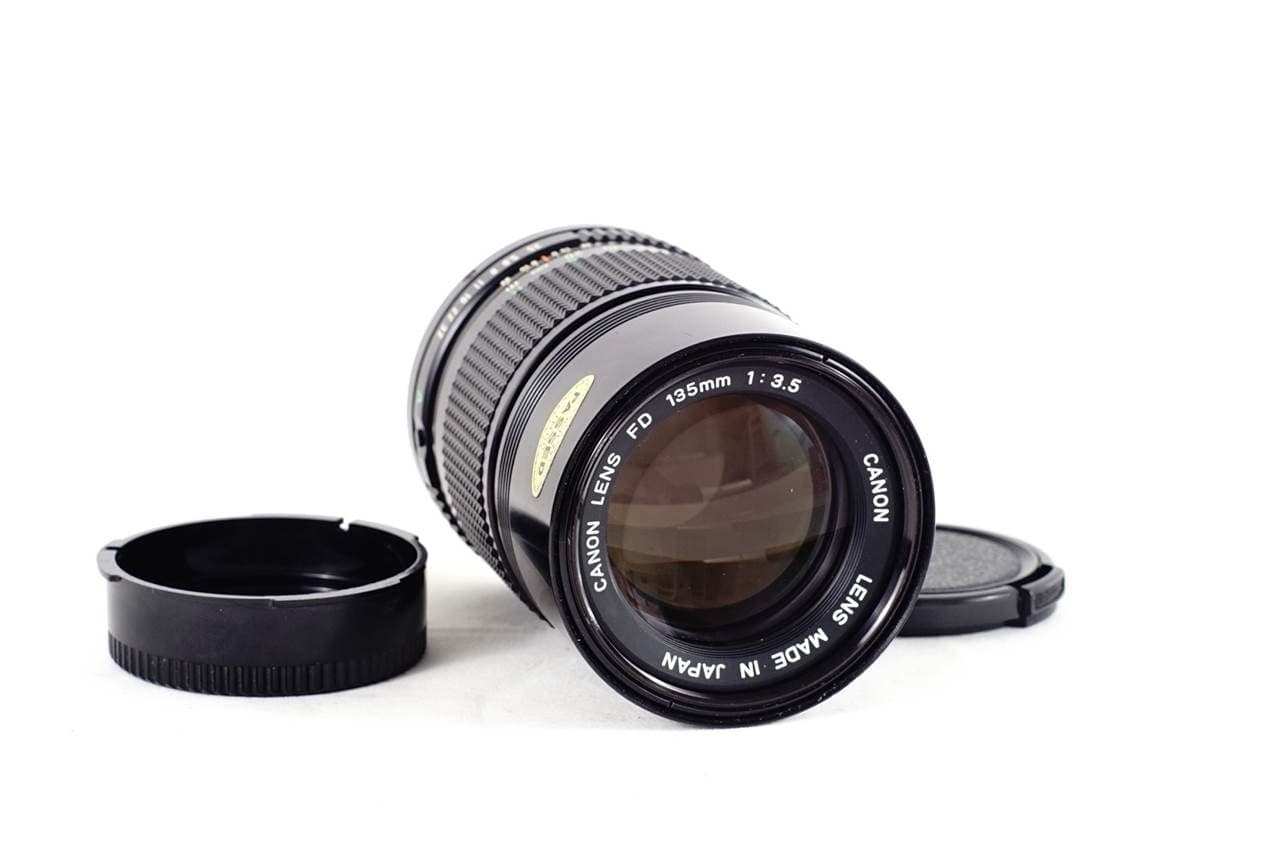
Canon Canon 135mm f3.5

Canon FD · 135mm · f/3.5

ยังไม่มีภาพสำหรับเลนส์นี้

ปีผลิต

1950

ผลิตที่

-

สูตรเลนส์

4 elements in 4 groups (New FD and 1976 FD); 4 elements in 3 groups (1970/1973 FD).

อัปเดต

4 ก.ค. 2569

เรื่องราวของเลนส์

The Canon 135mm f/3.5 is a long-running budget telephoto that spans multiple eras of Canon's optical history. Its origins reach back to a Leica Thread Mount (LTM) rangefinder version released around 1950, which was manufactured for roughly 25 years and appeared in 8 different versions—changes that, per Canon lore, were purely visual with the optical formula reportedly unchanged. On rangefinders, 135mm sits at the very upper limit of usability, framed via small dedicated framelines (as on the Canon Model 7) or an external viewfinder. The FD-mount lineage that followed had two major eras: the older FD version sold from 1970 to 1978, and the New FD (nFD) version introduced in 1979. The older FD line itself had three sub-versions: a 1970 original (4 elements/3 groups, 8 aperture blades), a 1973 lighter revision (same optics, 8 blades), and a 1976 version that switched to 4 elements in 4 groups with only 6 blades. All older FD variants used the simpler S.C. coating. The 1979 nFD version is lighter still, retains the 4-element/4-group design and 6 blades, but upgrades to the more advanced S.S.C. coating. This is a lens people love not for prestige but for value: it's small, light, cheap, and delivers performance that reviewers say rivals modern lenses costing dramatically more. No established nicknames are evidenced beyond the LTM reviewer's playful, personal remark that the long thin rangefinder version gives off 'clown vibes' on the camera—not an established community term.

สรุป: The Canon 135mm f/3.5 is a modest, honest, and remarkably affordable short telephoto that punches far above its price—especially the New FD version, whose S.S.C. coating, low vignetting, smooth bokeh, and sharp-across-the-frame performance rival far pricier glass. It's ideal for the budget-minded photographer who wants a compact, well-built 135mm for portraits and compression, and isn't bothered by the fiddly FD mount, plastic-heavy nFD construction, or the leisurely f/3.5 aperture. It's a great shooter but, as reviewers note, a less compelling collector's piece than Canon's more striking breech-lock lenses.

คาแรกเตอร์ของภาพ

โบเก้

บน New FD ให้โบเก้เนียนนุ่มแบบครีมมี่ โดยไม่เกิดรูปร่างหลายเหลี่ยมที่ชัดเจนจากแหล่งกำเนิดแสงแบบจุด

ความคม (เปิดสุด)

คมกริบที่กึ่งกลางภาพเมื่อเปิดรูรับแสงกว้างสุดที่ f/3.5; คมทั่วทั้งเฟรมเมื่อหรี่ลงเป็น f/5.6 โดยมีการเปลี่ยนระนาบโฟกัส (focus shift) ให้เห็น

แฟลร์

การเคลือบ New FD S.S.C. แทบจะขจัดแฟลร์ได้ทั้งหมด ในขณะที่รุ่น S.C. ที่เก่ากว่าจะมีความต้านทานต่อแฟลร์น้อยกว่า

วิกเน็ตติ้ง

ค่อนข้างต่ำ — ประมาณหนึ่งสต็อปเมื่อเปิดรูรับแสงเต็มที่ ประมาณ 0.4 สต็อปที่ f/5.6 และราว 0.2 สต็อปเมื่อหรี่รูรับแสงมากขึ้นบนเลนส์ nFD

รีวิวจากผู้ใช้

ข้อดี
  • Outstanding value—copies are found for as little as $20–$80, delivering performance reviewers say rivals lenses costing thousands
  • Razor-sharp center wide open and sharp across the whole frame by f/5.6 (New FD)
  • Smooth bokeh that avoids polygonal specular highlights (New FD)
  • Very low vignetting and near-total flare suppression thanks to S.S.C. coating (New FD)
  • Light, compact, and metal-bodied—reviewers note it feels much more robust than the smaller nFD 50mm and 28mm lenses
  • Smooth focus with a pleasant ~220° throw, engraved paint-filled markings, tight felt-lined built-in hood, and a non-rotating front for easy polarizer use
ข้อเสีย
  • The FD breech-lock mount is tedious, requiring perfect alignment to mount and remove
  • The aperture ring is a little stiff, as with many FD lenses
  • New FD construction uses a lot of plastic and doesn't 'scream quality' compared to contemporaries; some find it unattractive and consider it a poor collector's piece
  • 135mm on a rangefinder (LTM version) uses small framelines and sits in an awkward 'middle zone' focal length that many photographers rarely use
  • The slow f/3.5 maximum aperture is modest compared to faster 135mm alternatives
เทคนิคการใช้
  • Stop down to about f/5.6 for sharpness across the entire frame while keeping vignetting negligible
  • Because focus shift is present, refocus for the center rather than trusting infinity/near-stop focus positions
  • Use the non-rotating front barrel to your advantage with a polarizer
  • On mirrorless (e.g. Sony a7II, Canon EOS R) pair it with an L-bracket for better balance, as the lens can feel a tad long when the hood is extended
  • Prefer the New FD (S.S.C.) version if flare resistance matters; the older S.C. versions are less coated
  • For rangefinder use, a body with dedicated 135mm framelines (Canon Model 7) or a more magnified finder (Leica M3) makes the small framelines more usable

แหล่งอ้างอิง (1)

Web-grounded synthesissecondary

The Canon 135mm f/3.5 is a long-running budget telephoto that spans multiple eras of Canon's optical history. Its origins reach back to a Leica Thread Mount (LTM) rangefinder version released around 1950, which was manufactured for roughly 25 years and appeared in 8 different versions—changes that, per Canon lore, were purely visual with the optical formula reportedly unchanged. On rangefinders, 135mm sits at the very upper limit of usability, framed via small dedicated framelines (as on the Canon Model 7) or an external viewfinder. The FD-mount lineage that followed had two major eras: the older FD version sold from 1970 to 1978, and the New FD (nFD) version introduced in 1979. The older FD line itself had three sub-versions: a 1970 original (4 elements/3 groups, 8 aperture blades), a 1973 lighter revision (same optics, 8 blades), and a 1976 version that switched to 4 elements in 4 groups with only 6 blades. All older FD variants used the simpler S.C. coating. The 1979 nFD version is lighter still, retains the 4-element/4-group design and 6 blades, but upgrades to the more advanced S.S.C. coating. This is a lens people love not for prestige but for value: it's small, light, cheap, and delivers performance that reviewers say rivals modern lenses costing dramatically more. No established nicknames are evidenced beyond the LTM reviewer's playful, personal remark that the long thin rangefinder version gives off 'clown vibes' on the camera—not an established community term.

อยากได้Canon Canon 135mm f3.5?

ยังไม่มีในสต็อกตอนนี้ — ฝาก LINE หรืออีเมลไว้ เข้าเมื่อไหร่เราแจ้งทันที

LINEอีเมล