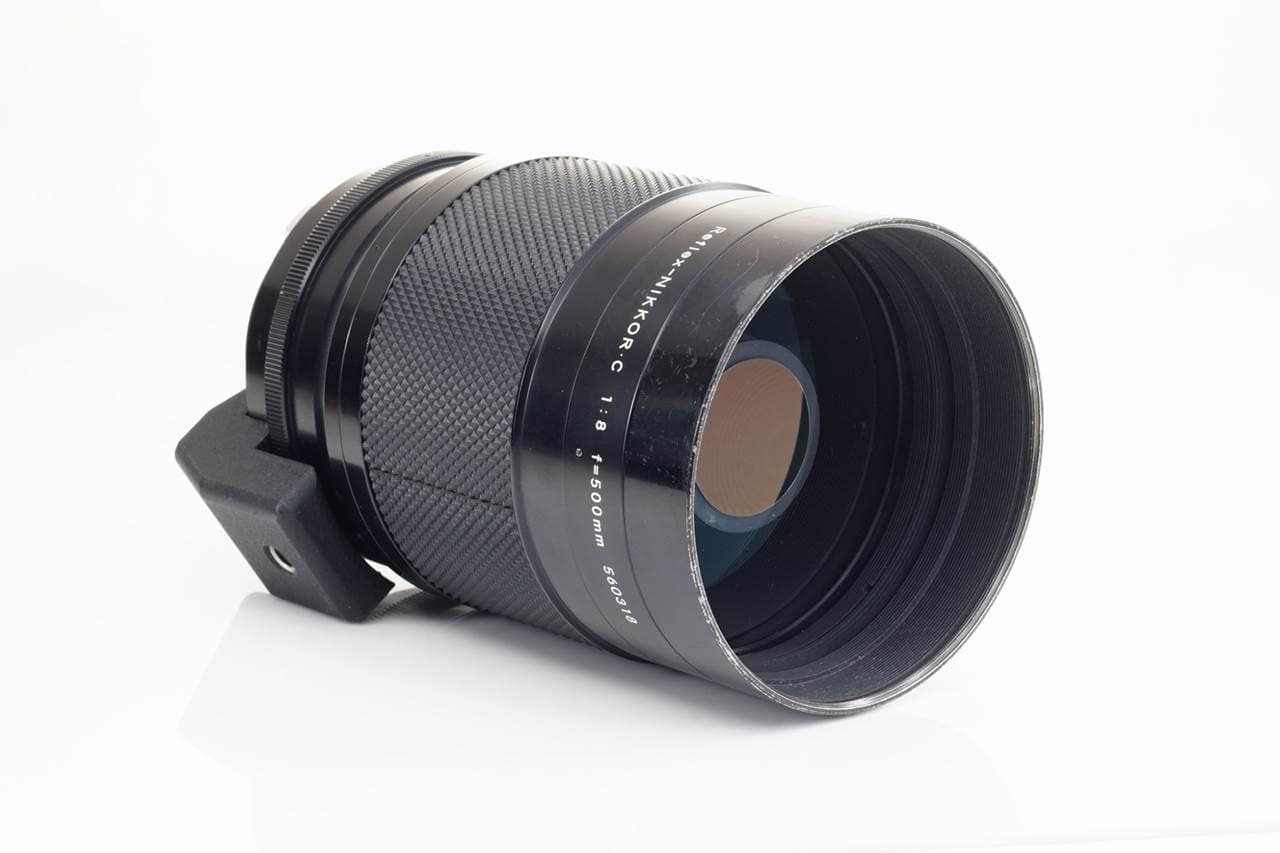
Nikon Nikon 500mm f8

Nikon Non-AI · 500mm · f/8

ยังไม่มีภาพสำหรับเลนส์นี้

ปีผลิต

1968 – 1983

ผลิตที่

-

สูตรเลนส์

Catadioptric (mirror) telephoto based on Maksutov astronomical telescope principle.

อัปเดต

1 ก.ค. 2569

เรื่องราวของเลนส์

The Nikon 500mm f/8 Reflex-NIKKOR belongs to Nikon's long-running family of catadioptric (mirror) telephotos, which began with the 50cm Reflex-Nikkor of 1961. The design uses a catadioptric ('cat') principle rooted in the work of Russian optical designer Maksutov, who developed it for large astronomical telescopes: light enters through a clear front element, bounces off a large rear mirror, is reflected back off a small mirror on the rear of the front element, and finally passes through a hole in the rear mirror to reach the film or sensor. This folded light path lets Nikon build a 500mm lens that is astonishingly small and light for its focal length. The version covered here is the Non-AI 500mm f/8 Reflex-NIKKOR-C (1968–1983), where the 'C' denotes fully multi-coated optics — a notable feature in its day. It was later superseded by the smaller 500mm f/8 N (1983–2005), which focused even closer and gained a macro/close-focus range. Roughly 32,000 units of the later Ai/N version were produced during its long run. Reviewers note these lenses are extremely common secondhand precisely because photographers keep buying them, discovering how hard they are to use, and reselling them. No established nickname or community jargon is evidenced in the reviews. The lens's cult following, such as it is, rests on its incredible reach-to-weight ratio, its bargain price (typically around $300 used), and its distinctive rendering — for landscape, moon shots, and even use as a telescope with the Nikon Lens Scope Converter.

สรุป: The Nikon 500mm f/8 Reflex-NIKKOR is a marvel of compact optical engineering that gives you 500mm of reach in a lens the size and weight of a normal prime — with essentially zero chromatic aberration and genuinely sharp centers. But it demands a lot: it's low in contrast, effectively f/11, prone to a central hot spot and ring-shaped bokeh, and painfully sensitive to vibration and focus error. It is a poor general-purpose photographic tool and a superb specialty lens. Buy it if you want cheap extreme reach, enjoy the mirror-lens aesthetic, and are willing to shoot at high shutter speeds with modern high-ISO or electronic-shutter cameras (and to fix contrast and hot spots in post). Avoid it if you need reliable, easy telephoto results or dislike doughnut bokeh.

คาแรกเตอร์ของภาพ

โบเก้

โบเก้รูปโดนัท (หรือแบบวงแหวน/แอนนูลาร์) ที่เกิดจากการบดบังของกระจกสะท้อนตรงกลาง — เอฟเฟกต์ที่บางคนหลงรัก แต่บางคนก็เกลียด

โทนสี

ไม่ให้คาแรกเตอร์เด่นชัดนัก — ชิ้นเลนส์ที่เคลือบหลายชั้นแบบเต็ม ('C') ถือเป็นข้อดี แต่คอนทราสต์ค่อนข้างต่ำมักทำให้ภาพดูจืดและความต่างของแสง-เงาลดลง

ความคม (เปิดสุด)

ให้ความคมชัดบริเวณกลางภาพสูงและรายละเอียดกลางภาพชัดเจนดีมาก แต่ตามมาตรฐานสมัยใหม่ถือว่าแทบจะพอใช้เท่านั้น (ค่าสูงสุดประมาณ 31.8 lp/mm บน Nikon D610) เนื่องจากคอนทราสต์ค่อนข้างต่ำจึงบดบังความคมชัดดังกล่าว

คอนทราสต์

มักถูกกล่าวว่าให้คอนทราสต์ต่ำ — ที่จริงเลนส์นี้มีความคม แต่ภาพมักดูคมชัดน้อย จึงมักต้องเพิ่มคอนทราสต์ในการปรับแต่งหลังการถ่ายภาพ

วิกเน็ตติ้ง

มีจุดร้อนเด่นตรงกลางภาพ พร้อมการมืดลงไปทางขอบ ซึ่งมีลักษณะแตกต่างจาก vignetting แบบปกติ แต่แก้ไขได้ง่ายในการปรับแต่งภาพหลังการถ่าย

รีวิวจากผู้ใช้

ข้อดี
  • Extraordinary reach in a tiny, lightweight package — a 500mm lens that weighs about as much as a standard lens (roughly 823g-1000g depending on version).
  • Essentially zero chromatic aberration, an inherent benefit of the mirror design.
  • Superb build quality; described as very well made, all-metal, with a silky-smooth manual focus and a built-in rotating tripod mount.
  • Very high underlying sharpness at the center once contrast is restored in post.
  • Excellent value — typically around $300 used, less than the sales tax on many big telephotos.
  • Great for use as a telescope with the Nikon Lens Scope Converter thanks to its strong central definition.
  • Works well for infrared photography (later version noted no IR hot spot) and benefits enormously from modern high-ISO digital bodies.
ข้อเสีย
  • Low contrast that makes images look softer than they truly are, requiring post-processing to fix.
  • Doughnut/ring-shaped bokeh that many find distracting.
  • Central hot spot with dimming toward the edges — an unusual and un-vignette-like brightness falloff.
  • Slow effective speed: marked f/8 but transmits closer to f/11 because the central mirror blocks light.
  • Extreme sensitivity to vibration; its tiny mass does nothing to damp camera shake, which is magnified ~10x. Nearly impossible to get sharp shots without very high shutter speeds or electronic shutter.
  • Difficult manual focusing: dim viewfinder image, paper-thin depth of field, and no aperture to hide focus errors. Split-image and microprism aids go black/useless on manual-focus bodies.
เทคนิคการใช้
  • Shoot at very fast shutter speeds — 1/500s minimum, and 1/2000s or faster for best handheld results — to overcome its extreme vibration sensitivity.
  • Push ISO up (ISO 800 or higher even in daylight) to reach those fast shutter speeds, since the lens is effectively f/11.
  • Counterintuitively, handheld can beat a tripod: your body mass dampens vibration better than a light tripod amplifies it. A beanbag is a good option for fixed use.
  • If using a tripod, prefer an electronic/silent shutter to avoid mechanical shutter shake, which is severe at this magnification.
  • Add contrast, clarity, and reduce blacks in post to counter the lens's low contrast and any central glow.
  • Correct the central hot spot / edge dimming in post — it fixes easily.
  • Add a focus-confirmation chip (e.g. a dandelion chip) for autofocus confirmation on Nikon Z/DSLR bodies to make focusing far easier.
  • Frame to keep busy backgrounds out of the frame if you want to avoid distracting doughnut bokeh; it's less of a problem in landscape work.

แหล่งอ้างอิง (1)

Web-grounded synthesissecondary

The Nikon 500mm f/8 Reflex-NIKKOR belongs to Nikon's long-running family of catadioptric (mirror) telephotos, which began with the 50cm Reflex-Nikkor of 1961. The design uses a catadioptric ('cat') principle rooted in the work of Russian optical designer Maksutov, who developed it for large astronomical telescopes: light enters through a clear front element, bounces off a large rear mirror, is reflected back off a small mirror on the rear of the front element, and finally passes through a hole in the rear mirror to reach the film or sensor. This folded light path lets Nikon build a 500mm lens that is astonishingly small and light for its focal length. The version covered here is the Non-AI 500mm f/8 Reflex-NIKKOR-C (1968–1983), where the 'C' denotes fully multi-coated optics — a notable feature in its day. It was later superseded by the smaller 500mm f/8 N (1983–2005), which focused even closer and gained a macro/close-focus range. Roughly 32,000 units of the later Ai/N version were produced during its long run. Reviewers note these lenses are extremely common secondhand precisely because photographers keep buying them, discovering how hard they are to use, and reselling them. No established nickname or community jargon is evidenced in the reviews. The lens's cult following, such as it is, rests on its incredible reach-to-weight ratio, its bargain price (typically around $300 used), and its distinctive rendering — for landscape, moon shots, and even use as a telescope with the Nikon Lens Scope Converter.

อยากได้Nikon Nikon 500mm f8?

ยังไม่มีในสต็อกตอนนี้ — ฝาก LINE หรืออีเมลไว้ เข้าเมื่อไหร่เราแจ้งทันที

LINEอีเมล