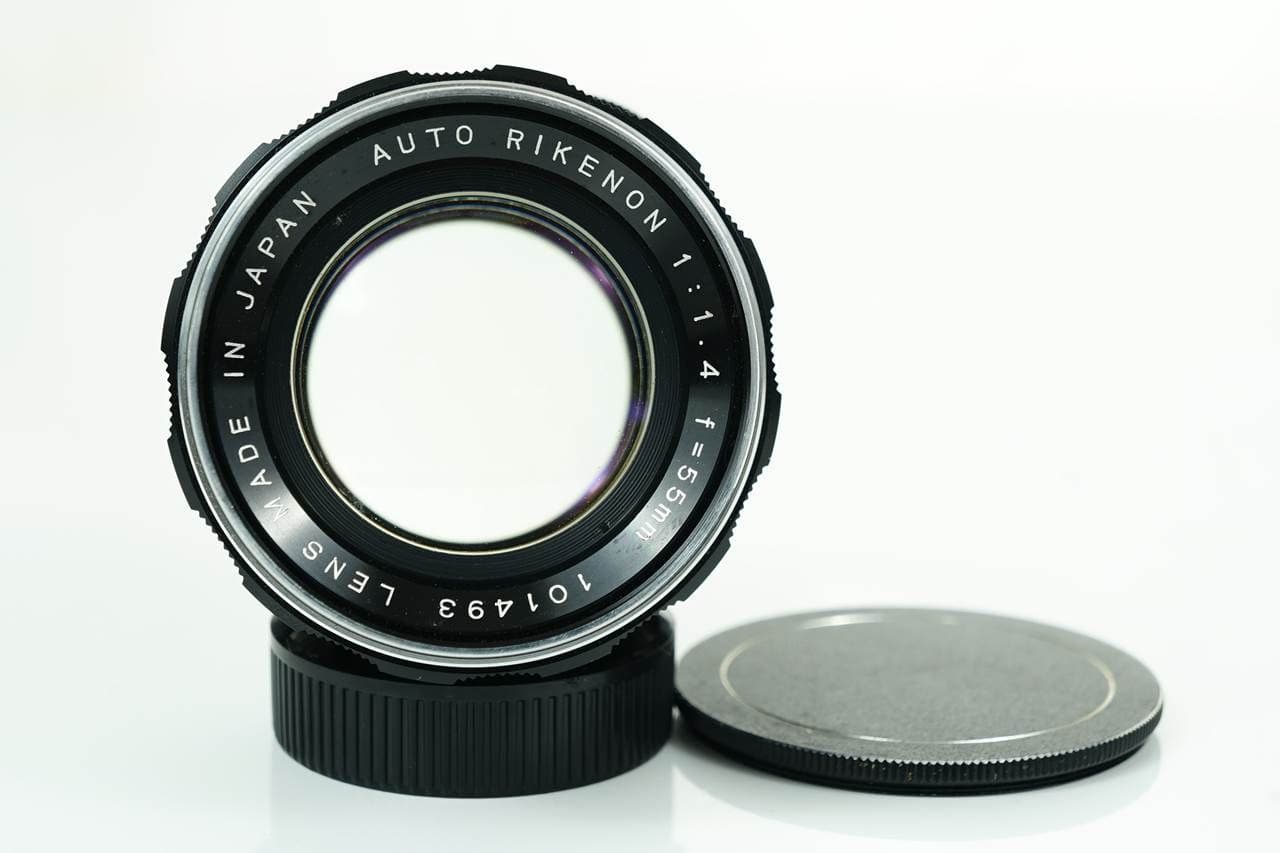
Rikenon Rikenon 55mm f1.4

M42 · 55mm · f/1.4

ยังไม่มีภาพสำหรับเลนส์นี้

ปีผลิต

1970

ผลิตที่

Japan

สูตรเลนส์

7 elements in 6 groups, Double-Gauss derivative

อัปเดต

17 ก.พ. 2569

เรื่องราวของเลนส์

The Rikenon 55mm f/1.4 was produced by Ricoh Company Ltd. of Japan, a manufacturer better known for their compact cameras and office equipment, yet one that produced surprisingly competent optics throughout the 1970s and 1980s. Ricoh's lens division operated somewhat in the shadow of giants like Canon, Nikon, and Pentax, which allowed them to focus on delivering exceptional value rather than prestige. The Rikenon 55mm f/1.4 emerged during the golden era of M42 mount lenses, when Japanese manufacturers were locked in fierce competition to produce the fastest, sharpest standard lenses possible. Ricoh's approach was pragmatic: deliver professional-grade optical performance at a fraction of the cost of the big-name alternatives. The lens was sold both under the Ricoh brand for their own camera bodies and as Rikenon for the broader M42 market. Unlike some budget offerings of the era, the 55mm f/1.4 was not a cost-cut design but rather a genuine fast standard lens built to compete with the likes of the Super Takumar 50mm f/1.4 and Pentax SMC 50mm f/1.4. Its cult following developed slowly, discovered by budget-conscious photographers who found that this overlooked lens could deliver results rivaling lenses costing three to four times as much. The lens is sometimes affectionately referred to by collectors as the 'Budget Bokeh King' due to its exceptional out-of-focus rendering at a fraction of the price of more famous fast fifties, though this nickname is not universally established.

สรุป: The Rikenon 55mm f/1.4 represents one of the vintage lens world's genuine hidden treasures. It offers roughly 80% of the optical performance of legendary fast fifties at perhaps 30% of the price, making it an ideal entry point for photographers curious about vintage glass or seeking a characterful portrait lens without significant investment. The lens excels for portraiture, artistic photography, and anyone who values smooth bokeh and warm color rendering over clinical perfection. It is not the lens for architecture, product photography, or any application demanding corner-to-corner sharpness. The ideal owner is a portrait photographer, street shooter, or creative experimenter who appreciates character over technical supremacy and values getting exceptional results without premium pricing. Those seeking the sharpest possible vintage 50mm should look elsewhere, but those seeking soul will find it here.

คาแรกเตอร์ของภาพ

โบเก้

Remarkably smooth and creamy bokeh with soft-edged circles, minimal outlining, and gradual background transitions; 6-blade aperture creates hexagonal highlights when stopped down past f/2.

โทนสี

Warm and slightly amber-tinted, particularly in neutral light, with flattering skin tones; multi-coated versions show more neutral tones while single-coated examples emphasize warmth.

ความคม (เปิดสุด)

Center sharpness is good but not exceptional wide open with soft glow; becomes excellent by f/2.8; corners lag behind at all apertures with peak sharpness at f/5.6-f/8.

แฟลร์

Single-coated versions are prone to significant veiling flare and ghosting; multi-coated versions handle flare considerably better but require a hood for challenging light.

คอนทราสต์

Moderate global contrast wide open, increasing significantly when stopped down; micro-contrast improves dramatically by f/2.8-f/4; veiling flare can reduce contrast in backlit situations.

วิกเน็ตติ้ง

Moderate to heavy vignetting at f/1.4 (approximately 1.5-2 stops in corners), becoming negligible by f/2.8; smooth character can be used creatively.

รีวิวจากผู้ใช้

ข้อดี
  • Exceptional bokeh quality that rivals or exceeds lenses costing significantly more, making it a genuine value proposition for portrait and artistic work
  • The warm, flattering color rendition that enhances skin tones without requiring post-processing adjustment
  • Solid mechanical construction with smooth focusing action that has often survived decades of use
  • The combination of dreamy wide-open character and sharp stopped-down performance provides versatility in a single lens
  • Genuinely affordable entry point into fast vintage standard lenses, often available for a fraction of the cost of comparable Takumar or Pentax options
  • The 55mm focal length provides slightly more reach than standard 50mm designs, useful for tighter portrait framing
  • Pleasant manual focus experience with well-damped helicoid and adequate focus throw for precise control
ข้อเสีย
  • Corner sharpness never fully catches up to center performance, even stopped down significantly
  • The 6-blade aperture creates hexagonal bokeh highlights when stopped down, which some find distracting
  • Single-coated versions struggle significantly with flare and contrast in backlit situations
  • Wide-open softness, while pleasing for portraits, can frustrate those seeking clinical sharpness
  • Less prestige and resale value compared to equivalent Pentax, Canon, or Zeiss branded lenses
  • Finding the multi-coated version can be difficult as most examples on the market are single-coated
  • The chrome-nose cosmetic design, while attractive, can cause reflections when shooting toward light sources
เทคนิคการใช้
  • Shoot wide open at f/1.4 for maximum bokeh effect and dreamy portrait rendering, accepting the softness as part of the aesthetic
  • For sharper results with retained background separation, f/2 offers a significant improvement over f/1.4 while maintaining shallow depth of field
  • Use a deep metal hood to combat the flare weakness, particularly important with single-coated versions
  • The warm color cast can be corrected in post or embraced as part of the vintage character depending on your vision
  • Focus slightly past the eyes for portraits shot wide open to account for focus shift and ensure critical focus on the subject
  • Stop down to f/4-f/5.6 for landscape and street photography where corner sharpness matters more
  • When adapting to mirrorless cameras, use a helicoid adapter to gain macro capability, as the minimum focus distance is relatively long

แหล่งอ้างอิง (1)

LLM generated secondaryAI สรุป

The Rikenon 55mm f/1.4 was produced by Ricoh Company Ltd. of Japan, a manufacturer better known for their compact cameras and office equipment, yet one that produced surprisingly competent optics throughout the 1970s and 1980s. Ricoh's lens division operated somewhat in the shadow of giants like Canon, Nikon, and Pentax, which allowed them to focus on delivering exceptional value rather than prestige. The Rikenon 55mm f/1.4 emerged during the golden era of M42 mount lenses, when Japanese manufacturers were locked in fierce competition to produce the fastest, sharpest standard lenses possible. Ricoh's approach was pragmatic: deliver professional-grade optical performance at a fraction of the cost of the big-name alternatives. The lens was sold both under the Ricoh brand for their own camera bodies and as Rikenon for the broader M42 market. Unlike some budget offerings of the era, the 55mm f/1.4 was not a cost-cut design but rather a genuine fast standard lens built to compete with the likes of the Super Takumar 50mm f/1.4 and Pentax SMC 50mm f/1.4. Its cult following developed slowly, discovered by budget-conscious photographers who found that this overlooked lens could deliver results rivaling lenses costing three to four times as much. The lens is sometimes affectionately referred to by collectors as the 'Budget Bokeh King' due to its exceptional out-of-focus rendering at a fraction of the price of more famous fast fifties, though this nickname is not universally established.

อยากได้Rikenon Rikenon 55mm f1.4?

ยังไม่มีในสต็อกตอนนี้ — ฝาก LINE หรืออีเมลไว้ เข้าเมื่อไหร่เราแจ้งทันที

LINEอีเมล