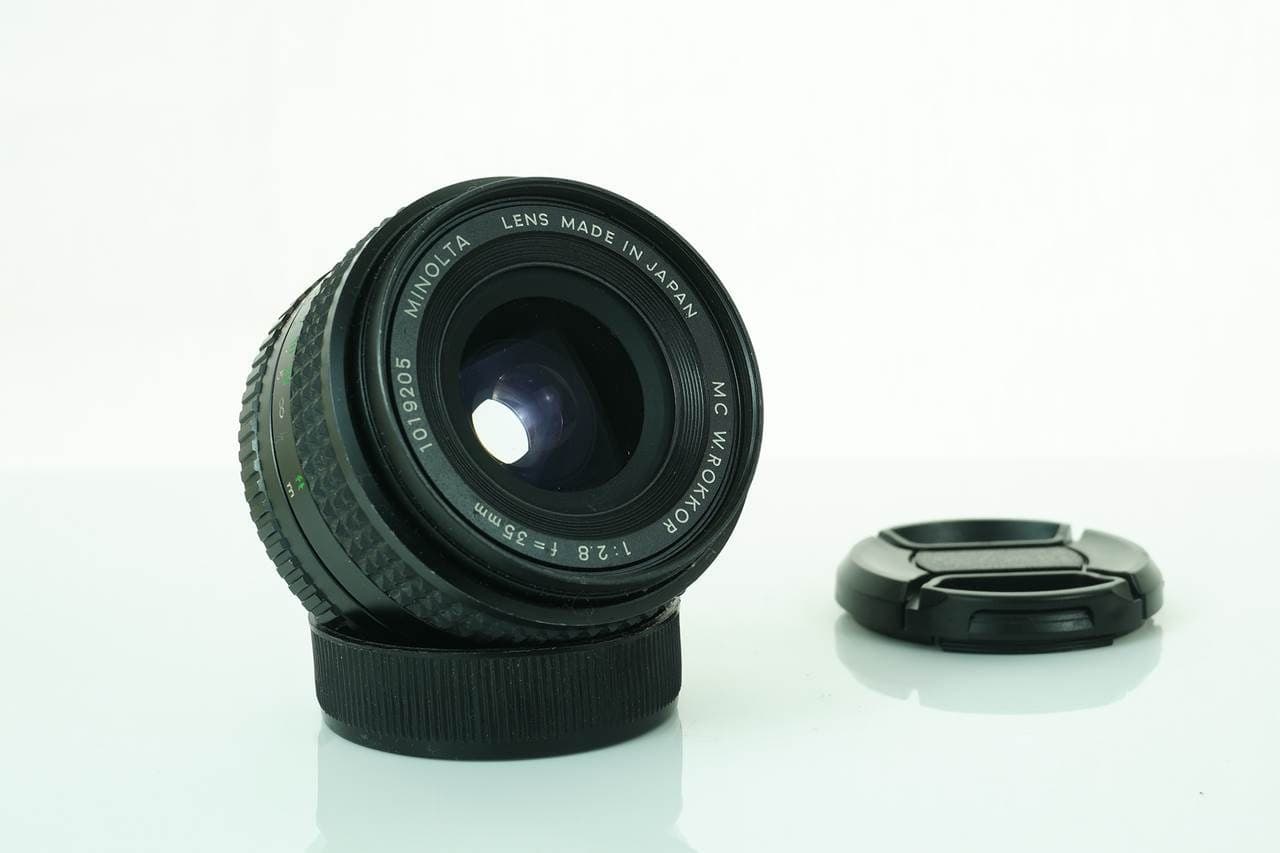
ปีผลิต
-
ผลิตที่
Japan
สูตรเลนส์
For the MC Rokkor-PF 58mm f/1.4, 6 elements in 5 groups (P=5 groups, F=6 elements).
อัปเดต
13 ก.ค. 2569
Minolta MD (SR mount)
ปีผลิต
-
ผลิตที่
Japan
สูตรเลนส์
For the MC Rokkor-PF 58mm f/1.4, 6 elements in 5 groups (P=5 groups, F=6 elements).
อัปเดต
13 ก.ค. 2569
The Rokkor name designates the optics of Minolta's SR-mount manual-focus system, spanning the MC and later MD generations that dominated the company's SLR era. Within this family the coding on the barrel tells a real story: on the celebrated MC Rokkor-PF 58mm f/1.4, the 'MC' does NOT mean multi-coating but 'Meter Coupled' — it let the lens communicate its selected aperture to the camera's light meter, a genuine convenience at the time. The two-letter optical code follows Minolta's own convention where the first letter counts groups and the second counts elements (on the PF: P = Penta/5 groups, F = Six/6 elements). The 58mm focal length itself is a historical artifact: before 50mm became the universal standard, a slightly longer 58mm made it easier for engineers to clear the flipping SLR mirror while keeping a large f/1.4 aperture. The standout MC Rokkor-PF 58mm f/1.4 is described as a legendary piece of glass and is sometimes called the 'bokeh king' of its era, loved for its dreamy wide-open look that firms up into a fairly sharp performer stopped down. A note on radioactivity: unlike the Takumar 50mm f/1.4 of the period, the Rokkor PF 58mm f/1.4 does NOT use Thorium elements, so its glass does not yellow — but the faster 58mm f/1.2 is radioactive. The line's cult following rests on this character-over-clinical-sharpness reputation and its still-affordable used pricing.
สรุป: The Minolta Rokkor line is for the photographer who prizes vintage character over clinical perfection. Its fast standard primes — headlined by the 'bokeh king' MC Rokkor-PF 58mm f/1.4 — reward you with a soft, dreamy, low-contrast look wide open that firms into genuine sharpness once stopped down, all in beautifully built metal bodies at approachable prices. Buy it for mood, portraits and atmosphere; look elsewhere if you need edge-to-edge bite wide open, and choose the specific focal length carefully, since the wide-angles are far more uneven than the standards.
58mm f/1.4 ให้โบเก้เรียบเนียนและฝันๆ ในฐานะ 'ราชาโบเก้' แม้คุณภาพจะแตกต่างกันในตระกูล โดยเลนส์มุมกว้างบางรุ่นให้พื้นหลังที่ดูวุ่นหรือไม่น่าดึงดูด
นุ่มและฝันๆ เมื่อเปิดกว้างสุดในเลนส์ไพรม์ความเร็วสูง โดย 58mm f/1.4 คมขึ้นอย่างมากที่ f/2 กลายเป็นเลนส์ที่ค่อนข้างคม
คอนทราสต์โดยรวมต่ำเมื่อเปิดกว้างสุดในเลนส์ไพรม์ความเร็วสูง แต่จะเพิ่มขึ้นอย่างชัดเจนเมื่อหรี่รูรับแสงลง
สำหรับ 58mm f/1.4 ขอบดำปานกลางประมาณ 1.5 EV เมื่อเปิดกว้างสุด ลดลงเกือบครึ่งที่ f/2 และแทบไม่มีตั้งแต่ f/2.8
อะแดปเตอร์จริงจากร้านที่ใช้กับเมาท์ของเลนส์นี้ได้
Standard · ฿540 · มีสินค้า
Standard · ฿540 · มีสินค้า
Standard · ฿540 · มีสินค้า
Standard · ฿1,250 · มีสินค้า
Standard · ฿890 · หมด
Standard · หมด
Standard · หมด
The Minolta Rokkor line is for the photographer who prizes vintage character over clinical perfection. Its fast standard primes — headlined by the 'bokeh king' MC Rokkor-PF 58mm f/1.4 — reward you with a soft, dreamy, low-contrast look wide open that firms into genuine sharpness once stopped down, all in beautifully built metal bodies at approachable prices. Buy it for mood, portraits and atmosphere; look elsewhere if you need edge-to-edge bite wide open, and choose the specific focal length carefully, since the wide-angles are far more uneven than the standards.