Production
1960 – 1989
Country
Japan
Optical
4-7 elements in 4-6 groups
Updated
Jul 15, 2026
M42 and K-mount · 28mm · f/2.5
Production
1960 – 1989
Country
Japan
Optical
4-7 elements in 4-6 groups
Updated
Jul 15, 2026
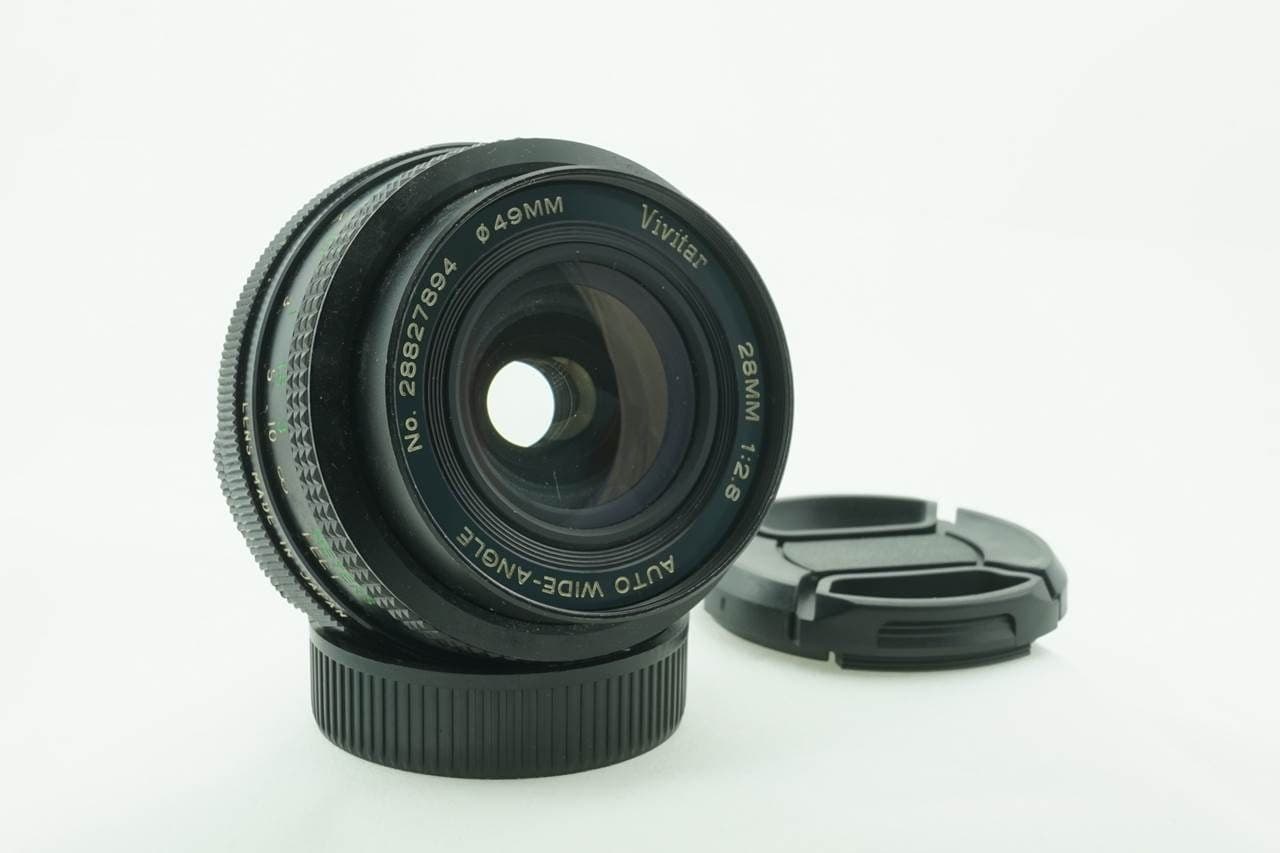
The Vivitar 28mm f/2.5 belongs to the era when Vivitar operated as a badge-engineering house rather than a manufacturer, commissioning lenses from Japanese third parties and selling them under its own name. According to the reviews, this wide-angle was most often built by Kiron, and collectors identify the Kiron-made copies by their serial numbers — 'Kiron' being the only real piece of jargon attached to the lens, used to denote a specific (and generally respected) maker rather than a nickname. The sources are explicit that there is no established nickname for this lens; do not expect one. Its following is modest and practical rather than cultish: people gravitate to it as a solidly-built, character-driven budget wide-angle with a genuinely excellent metal barrel and focus action, accepting its optical quirks as the price of a cheap, tactile shooter. Reviewers consistently frame it as 'nice, pleasant, good value but not stellar,' and several note that the separate f/2.8 Vivitar 28mm is rated more highly than this f/2.5 version.
Verdict: The Vivitar 28mm f/2.5 is for the manual-focus enthusiast who wants a beautifully built, tactile budget wide-angle and is willing to work around its optics rather than fight them. In good, controlled light it delivers reasonable sharpness, low distortion, and pleasant colour; point it toward the sun and its large front element flares badly, vignetting is heavy wide open, and its bokeh turns inconsistent with ringed highlights. Buy it for the character and the superb focus feel, not for clinical performance — and if uncompromised optics matter more, the separate f/2.8 version is the more highly regarded choice.
Inconsistent—sometimes very nice, sometimes mediocre—with circular ringed highlights attributed to flare from the large front element.
Decent colour rated slightly behind a Pentax M 28mm f/2.8.
Reasonable to good even wide open with some lack of fine detail, improving when stopped down; copy-to-copy variation noted.
Poor—strong fear of backlight and prone to flare due to the unusually large front element.
Decent but readily degraded by flare in backlit conditions.
Very severe at f/2.5 wide open, easing as the lens is stopped down.
Real adapters from our shop that fit this lens mount.
Standard · ฿325 · In stock
Standard · ฿325 · In stock
Standard · ฿325 · In stock
Standard · ฿325 · In stock
Standard · ฿540 · In stock
Standard · ฿540 · In stock
Standard · ฿540 · In stock
Standard · ฿540 · In stock
Standard · ฿540 · In stock
Standard · ฿1,250 · In stock
Standard · ฿890 · Out of stock
Standard · ฿890 · Out of stock
The Vivitar 28mm f/2.5 is for the manual-focus enthusiast who wants a beautifully built, tactile budget wide-angle and is willing to work around its optics rather than fight them. In good, controlled light it delivers reasonable sharpness, low distortion, and pleasant colour; point it toward the sun and its large front element flares badly, vignetting is heavy wide open, and its bokeh turns inconsistent with ringed highlights. Buy it for the character and the superb focus feel, not for clinical performance — and if uncompromised optics matter more, the separate f/2.8 version is the more highly regarded choice.
The Vivitar 28mm f2.5 is a solid vintage lens option with reliable performance. Community members recommend it as a capable performer for photographers seeking good optical quality combined with vintage character and affordability.
The Vivitar 28mm f2.5 is a solid vintage lens option with reliable performance. Community members recommend it as a capable performer for photographers seeking good optical quality combined with vintage character and affordability.