Production
1950 – 1989
Country
East Germany (DDR)
Optical
4 elements in 3 groups
Updated
Feb 6, 2026
M42 · 50mm · f/2.8
Production
1950 – 1989
Country
East Germany (DDR)
Optical
4 elements in 3 groups
Updated
Feb 6, 2026
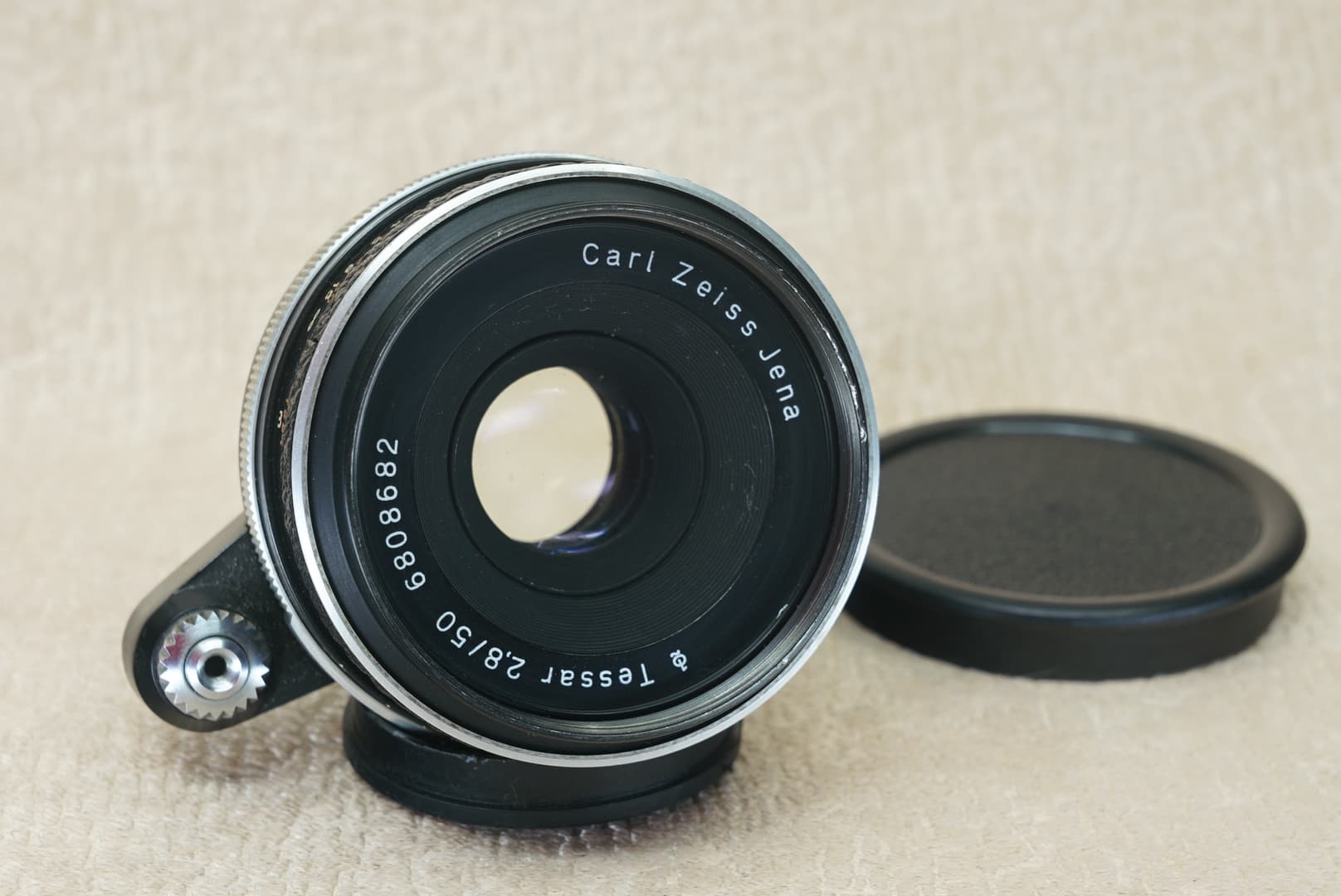
The Carl Zeiss Tessar is one of the most historically significant optical designs in photographic history, earning its legendary nickname 'The Eagle Eye' (Adlerauge) for its exceptional sharpness. The original Tessar design was patented by Paul Rudolph at Carl Zeiss Jena in 1902, evolving from the earlier Protar design. The name derives from the Greek 'tessera' meaning four, referencing its four-element optical construction. The M42 screw mount versions were primarily produced by Carl Zeiss Jena (East Germany) from the 1950s through the 1980s, making them accessible to a vast number of photographers during the golden age of 35mm photography. The Tessar became the standard by which other lenses were judged for decades, and its design was copied and adapted by virtually every major lens manufacturer worldwide. The cult following stems from its remarkable center sharpness even wide open, its honest and clinical rendering that defined what 'good' meant for generations, and its place as the lens that documented much of the 20th century's most important moments. Professional photographers trusted it implicitly, and the design's influence extends to modern smartphone camera modules that still use Tessar-type configurations.
Verdict: The Carl Zeiss Tessar in M42 mount is a lens for photographers who value precision, history, and optical honesty over romantic rendering. It rewards those who understand its strengths—exceptional center sharpness, excellent micro-contrast, and geometric accuracy—and work within its limitations. This is not the lens for creamy portrait bokeh or dramatic shallow depth-of-field effects. It is, however, perfect for street photography, documentary work, landscapes, and anyone who wants to own a piece of optical history that still delivers meaningful image quality on modern cameras. The Tessar is a masterclass in doing more with less—four elements producing sharpness that embarrassed many more complex designs. For the price these command today, it represents remarkable value for anyone who appreciates what it was designed to do.
Busy and nervous bokeh with double-edging on highlights; unsuitable for smooth background separation in portraits.
Neutral to slightly cool with restrained saturation; single-coated versions exhibit warmer tones.
Legendary center sharpness wide open earning its 'Eagle Eye' reputation; corners improve significantly by f/5.6-f/8.
Single-coated versions prone to significant veiling flare; T-coated versions handle flare much better but still show warm ghosting.
Exceptional micro-contrast in center with moderate global contrast; single-coated versions show lower contrast in backlit situations.
Moderate vignetting wide open at approximately 1.5-2 stops in corners; negligible by f/5.6.
Real adapters from our shop that fit this lens mount.
Standard · ฿325 · In stock
Standard · ฿325 · In stock
Standard · ฿325 · In stock
Standard · ฿325 · In stock
Standard · ฿540 · In stock
Standard · ฿540 · In stock
Standard · ฿540 · In stock
Standard · ฿540 · In stock
Standard · ฿540 · In stock
Standard · ฿1,250 · In stock
Standard · ฿890 · Out of stock
Standard · ฿890 · Out of stock
The Carl Zeiss Tessar in M42 mount is a lens for photographers who value precision, history, and optical honesty over romantic rendering. It rewards those who understand its strengths—exceptional center sharpness, excellent micro-contrast, and geometric accuracy—and work within its limitations. This is not the lens for creamy portrait bokeh or dramatic shallow depth-of-field effects. It is, however, perfect for street photography, documentary work, landscapes, and anyone who wants to own a piece of optical history that still delivers meaningful image quality on modern cameras. The Tessar is a masterclass in doing more with less—four elements producing sharpness that embarrassed many more complex designs. For the price these command today, it represents remarkable value for anyone who appreciates what it was designed to do.