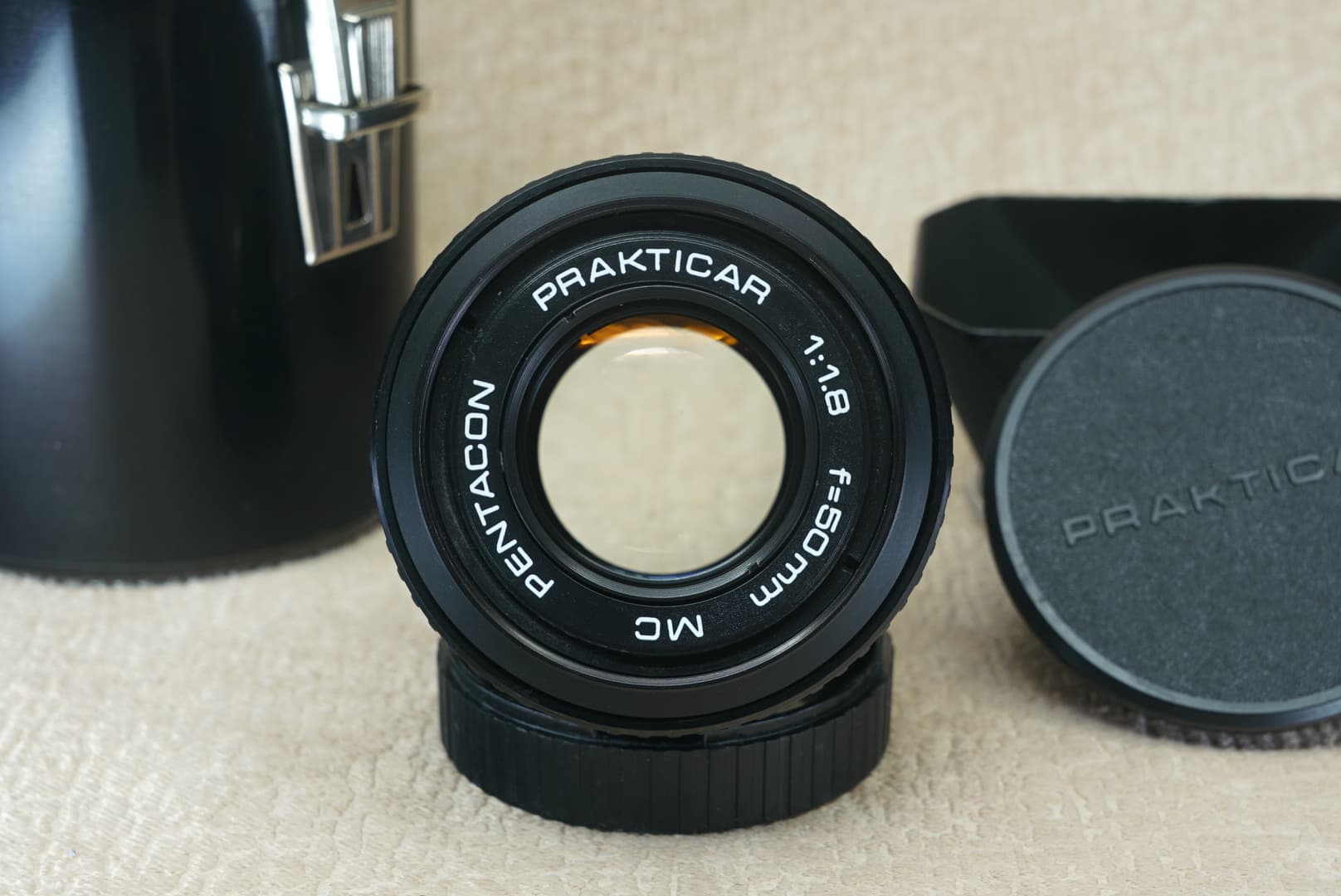
Production
1960 – 1990
Country
East Germany (GDR)
Optical
Descendant of the Meyer-Optik Oreston (double Gauss variant), 7 elements in 6 groups.
Updated
Jul 15, 2026
M42 screw mount · 50mm · f/1.8
Production
1960 – 1990
Country
East Germany (GDR)
Optical
Descendant of the Meyer-Optik Oreston (double Gauss variant), 7 elements in 6 groups.
Updated
Jul 15, 2026
The Pentacon 50mm f1.8 emerged from East German optical manufacturing heritage, produced during the height of the Cold War era. Originally designed as the Meyer Oreston or by Pentacon for M42 screw mount cameras, this lens represents decades of refinement from classical German optical design principles. It was widely distributed across Eastern Bloc countries and became a staple standard lens for Praktica, Pentacon, and other Eastern European SLR systems. The lens evolved through several iterations, including the 'Auto' versions and later MC (multi-coated) variants, eventually finding new life as a beloved budget-friendly option for modern digital and film cameras through adapter rings.
Verdict: The Pentacon 50mm f1.8 is a genuine hidden gem in the vintage lens market. For photographers seeking character over clinical perfection, this lens represents extraordinary value. Forum users consistently praise it as an excellent lens that has been left unused for years and still delivers superior results compared to other budget 50mm options. This is an essential addition to any vintage lens collection, particularly for those adapting lenses to modern cameras.
Natural and slightly warm rendering.
Centre resolves decently wide open but with low contrast and spherical-aberration glow; f/2.5 boosts contrast and sharpness, though corners stay soft from field curvature.
Low contrast wide open from spherical-aberration glow; contrast boosts markedly by f/2.5.
Mild vignetting wide open, reducing significantly by f/2.8–f/4.
The Pentacon 50mm f1.8 is a genuine hidden gem in the vintage lens market. For photographers seeking character over clinical perfection, this lens represents extraordinary value. Forum users consistently praise it as an excellent lens that has been left unused for years and still delivers superior results compared to other budget 50mm options. This is an essential addition to any vintage lens collection, particularly for those adapting lenses to modern cameras.
According to DPReview forum users, the Pentacon 50mm f1.8 is a budget-friendly option that offers excellent performance, particularly when stopped down. Users report it performs comparably or better than competing vintage 50mm lenses from the same era. It's praised as an affordable way to explore vintage lens collecting and adapted lens photography on modern mirrorless systems. The multiple variants available make it interesting for collectors wanting to compare different coating generations. Essential for budget-conscious photographers exploring vintage glass.
The Pentacon Auto 50mm f/1.8 — the 'Bubble Bokeh Monster' — is for the photographer who wants character over clinical perfection. Shoot it wide open and it rewards you with soft, glowing, low-contrast vintage images and its signature outlined soap-bubble backgrounds; stop it down to around f/2.5 and it becomes a sharper, more contrasty, practical normal lens (corners aside). It is not the pick if you demand edge-to-edge sharpness or strong flare resistance, but as an inexpensive, rugged, personality-packed portrait and mood lens, it earns its cult following.